Home on Wheels, Water from Air
2025/09/29
I. First, Understand: Differences in Fresh Water Tank Capacities Among Different RVs
The capacity of an RV's fresh water tank is strongly related to the vehicle's size and design orientation, ranging from approximately 100 liters for compact models to 500 liters for large RVs. Below are the typical capacity ranges of 6 mainstream RV categories, providing a basic reference for subsequent water consumption calculations:
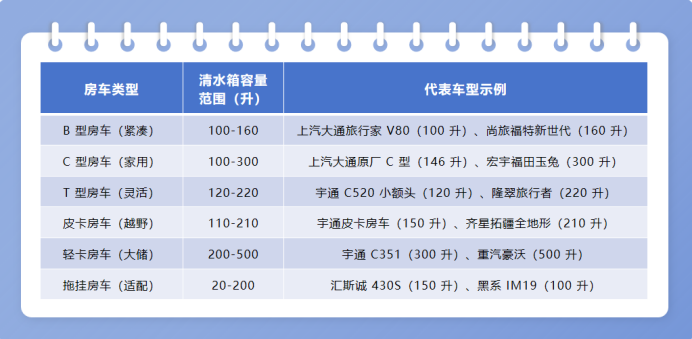
Note: Some models are equipped with a "main tank + auxiliary tank" (e.g., Zhongtian Navigator Type T RV: 140L main tank + 70L auxiliary tank). The total capacity should be calculated during actual use.
II. Core Scenario Analysis: How Much Water Does an RV Fresh Water Tank Use Per Day?
There is no fixed standard for RV water consumption, but it can be estimated using the formula "per capita daily basic consumption + scenario-based additional consumption". Assuming an adult lives in an RV, the water consumption varies across different scenarios as follows, and calculations can be adjusted by multiplying based on the number of people traveling together:
1. Basic Scenarios: Drinking + Simple Hygiene (3-5 Liters Per Person Per Day)
- Drinking: According to the recommendations in the Chinese Residents' Dietary Guidelines, adult men need 1.7 liters of water per day, and adult women need 1.5 liters. For 2 people traveling together, the daily water consumption for drinking is approximately 3-3.5 liters (including water for making tea and coffee).
- Simple Hygiene: Brushing teeth in the morning and evening (0.2-0.3 liters each time) and washing the face (about 0.5 liters per time using a basin). For 2 people, the daily consumption is around 1.8-2.2 liters. If running water is used for hygiene, the water consumption will double (increasing to 3-4 liters).
- Total: For 2 people traveling together, the daily water demand for basic drinking and hygiene is 4.8-7.2 liters. A 100-liter fresh water tank can last for 14-21 days (for basic scenarios only).
2. High-Frequency Scenario: Cooking (5-15 Liters Per Person Per Day, Varying by Meal Size)
Water consumption for cooking is directly related to the "complexity of the meal". The consumption gap between simple meals for 1-2 people and group meals for multiple people can be up to 3 times. Specific references are as follows:
- Simple Meals for 1-2 People (1 meat dish + 1 vegetable dish + rice): Water for ingredient cleaning (1-2 liters for vegetables, 1-3 liters for meat) + water for rinsing rice (0.5-1 liter) + water for stir-frying/cooking soup (2-3 liters), totaling 5-8 liters per day.
- Home-Style Meals for 3-4 People (2 meat dishes + 2 vegetable dishes + soup): Water for cleaning additional ingredients (an extra 2-4 liters) + water for blanching (3-5 liters) + water for cleaning cookware (2-3 liters), totaling 15-25 liters per day.
- Example: For a Class B RV (with a 100-liter fresh water tank), if 2 people cook one simple meal per day, the water consumption for cooking is 5-8 liters. When combined with basic drinking and hygiene needs, the total daily water consumption is approximately 10-15 liters, and a 100-liter tank can last for 7-10 days.
3. Major Water Consumer: Bathing (20-100 Liters Per Time, Varying by Method)
Bathing is the "largest variable" in RV water consumption. The shower method (ordinary showerhead / water-saving showerhead) and duration directly affect the tank's endurance, and may even cause a 100-liter tank to be "empty in one day":
- RV-Specific Water-Saving Showerhead: Water output is 4-6 liters per minute. If the bathing duration is controlled to 5-8 minutes (with the water turned off while lathering), the water consumption per bath is 20-40 liters. For 2 people taking one bath each day, the consumption is 40-80 liters.
- Ordinary Showerhead (Non-Water-Saving): Water output is 8-12 liters per minute. An 8-minute bath consumes 60-100 liters of water per time, meaning one bath by a single person will use up most of the tank (e.g., only 0-40 liters remain in a 100-liter tank).
- Key Reminder: If an RV is equipped with a 100-150 liter fresh water tank, it is recommended to prioritize a water-saving showerhead. Otherwise, you may need to refill the tank immediately after bathing, which will affect subsequent water use (such as cooking and hygiene).
4. Other Scenarios: Cleaning and Emergency (2-5 Liters Per Day)
- Tableware/Cookware Cleaning: Without a dishwasher, 2 people need 2-3 liters of water per day for washing dishes (using a basin to soak dishes). If running water is used for rinsing, the water consumption increases to 5-8 liters.
- RV Interior Cleaning: Wiping tables, mopping the floor, etc., requires 1-2 liters of water per day (using a bucket to hold water and avoiding running water).
- Emergency Water Use: For purposes such as refilling water for pets and cleaning outdoor equipment, it is safer to reserve 2-3 liters of water.
III. Practical Calculation: Reference for "Tank Endurance Days" of Different RVs
Based on the above scenario-based consumption, we calculate the fresh water tank endurance days of 6 mainstream RV categories under the standard of "2 people traveling together, 1 simple meal per day, 1 water-saving shower per day", helping you intuitively determine "how often to refill the tank":
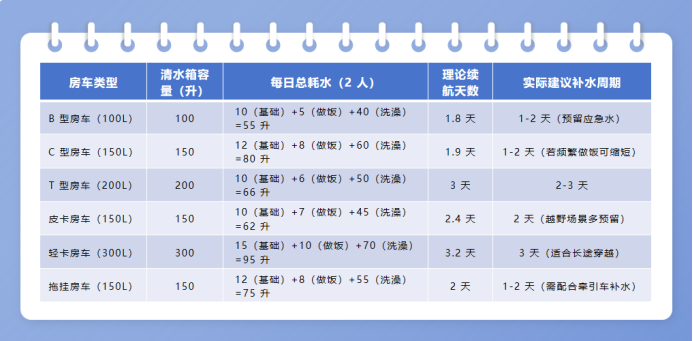
Note: Actual endurance will be affected by factors such as "whether water-saving equipment is installed", "whether hot water is used frequently (heating consumes a small amount of water)", and "weather (high temperatures may increase drinking water demand)". It is recommended to plan refilling based on 70%-80% of the theoretical days.
IV. 4 Key Recommendations for RV Water Use
- Prioritize equipping with "water-saving equipment" to extend endurance.
- Winter Travel: It is recommended to reserve 20% of the tank capacity (to prevent freezing from occupying space).
- Monitor water volume in real time to avoid "water cutoff crises".
- Equip with an atmospheric water generator—where there is air, there is water.
BET China produces atmospheric water generators of various specifications, meeting diverse needs such as irrigation, drinking, and hygiene. The capacity and body of the generators can be customized according to requirements.
You can contact us via email: bet@thegetglobal.cn
